Foundation logo 2rev
A Frontier Kidnapping

The lives of Jemima Boone, and Sisters Elizabeth and Frances Callaway
after being rescued from five Cherokee and Shawnee Indians in 1776

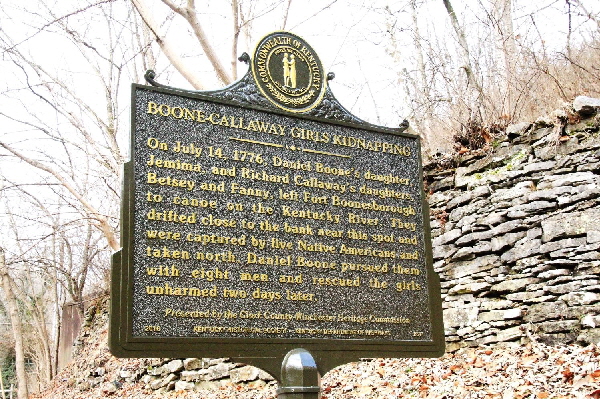
Marker 2511

Historical Marker #2511: Located near the Kentucky River at 363 Athens-Boonesboro Road, Winchester, KY, Clark County (37.906459, - 84.268907)

After the rescue of the three girls they all returned to Fort Boonesborough for some much needed rest and celebration by all. This experience was definitely a very emotional time for them and their families. In August, following their rescue, news of the Declaration of Independence reached Boonesborough; another cause for celebration.

The following material is provided so the reader has some insight as to what happened to each girl after their rescue. For additional information on their capture, rescue, and their later life one can use the references provided.

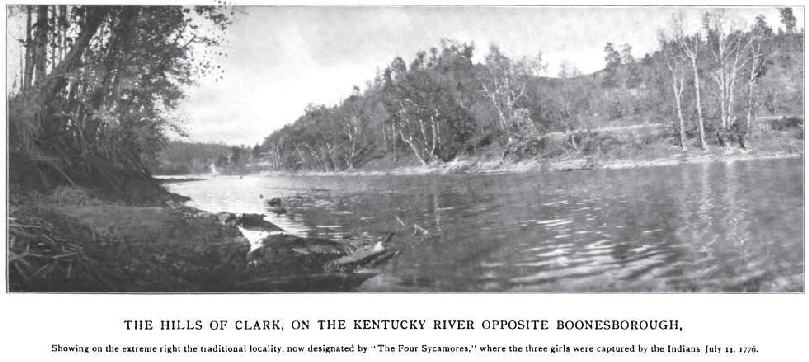
The Hills of Clark

Historical Photo (believed to have been taken sometime prior to the construction of Lock and Dam #10,) up stream of the Fort on the Kentucky River in 1905.

Quoting the caption above – “Showing on the extreme right the traditional locality, now designated by ‘The Four Sycamores,’ where the three girls were captured by the Indians July 14, 1776”.

Jemima. Jemima was born in North Carolina in 1762 and moved to Boonesborough with her mother and five brothers and two sisters in September, 1775. She was about 14 years old in 1776 when she was captured on the Kentucky River with the Callaway sisters Betsy (Elizabeth) and Fanny (Frances). At the time of their capture Betsy was engaged to Samuel Henderson, Colonel Richard Henderson’s nephew, and three weeks after the rescue they were married at Fort Boonesborough. Within a year Jemima married Colonel Callaway’s nephew, Flanders Callaway, brother of Betsy and Fanny, but Fanny didn’t marry John Holder until 1782 or 1783; Flanders and John (by some accounts) were among the mounted rescuers with Colonel Callaway, while Samuel accompanied Daniel Boone and others on foot to rescue the girls.

After their rescue Jemima stayed close to Daniel and remained at Fort Boonesborough after Daniel and the other salt makers were captured by the Shawnee in February 8, 1778. After that her mother Rebecca, assuming Daniel was dead, took Jemima’s siblings and returned to the Yadkin valley in North Carolina to be with family.

Jemima was at the Fort during the siege of 1778 and helped Daniel load his rifle, molding/casting and distributing lead bullets (musket balls), at times by candlelight for everyone’s firearms. Many of these bullets were so hot she had to carry them in her apron. She also helped put out fires started by flaming arrows on some of the cabin roofs. At one point she was struck by a spent bullet in the back, but it didn’t penetrate her clothing so it was easily removed. According to her sister-in-law, Jemima at the time was only dressed in her underclothes; shift and petticoats.

The battle was terrifying for those in the Fort. The Indians attacked day and night, shooting flaming arrows into the fort during the day, running up to the walls and throwing torches inside during the night. Thousands of bullets were fired at the fort. Most would hit the walls and fall to the ground as they tried to save powder by using partial loads, thus, ballistically the bullets didn’t possess much penetrating energy to become embedded in the logs when they struck the walls of the fort.  The fort wall facing the hills north of the Kentucky River gave the Indians a particularly better advantage point from which to shoot into the interior of the fort, however, the distance or range was greater when shooting from across the river. Some of the women, possibly including Jemima, would venture out at night under cover of darkness and collect as many of these bullets as they could on their hands and knees so that they could remold them into new bullets.  They were compelled to do this because lead supplies were limited.  Because of this, it has been said that some melted down their personal pewter kitchenware to mold bullets. During and after the siege was over it was reported that as much as 125 lbs. of lead bullets were recovered at the base of the fort walls, besides what was embedded in the log walls of the fort.

Jemima and Flanders were married almost 50 years and had ten children. Early in their marriage they moved around to different places in Kentucky, including Boone’s Station at present day Athens, Kentucky and Marble Creek area near Spears, Kentucky. They later moved in 1798 or 1799 to Missouri, near Femme Osage creek, to be close to Daniel and Rebecca who were living with her brother Nathan Boone and family at the time.

Flanders and Jemima were founders of Friendship Baptist Church in Charette, present day Marthasville, Missouri. Flanders was previously a charter member of Marble Creek Baptist Church near Spears, Kentucky. That congregation still thrives as East Hickman Baptist Church, which moved to its current location in 1803 in Southwest Fayette County Kentucky just a few miles from the original church.

Jemima was said to be a very attractive lady. Her mother Rebecca Boone passed away in Jemima’s home in 1813. Daniel Boone also lived with Jemima and Flanders for some time, but later at his request, was taken to Nathan’s home where he died in 1820. He was then taken back to Jemima and Flanders home for his funeral; which took place in the barn, and attended by a large crowd. Flanders Callaway died in 1829 and Jemima died on August 30, 1834.

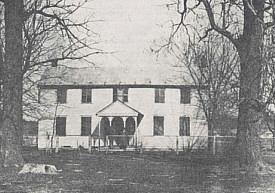
Flanders and Jemima Home

Flanders and Jemima’s home was built about 1812, on their farm of over 1,000 acres. It was a two-story, five bay, walnut hewn-log frontier house. The house was typical of early Federal style log construction. It was formerly located near Marthasville, Warren County, Missouri, before it was relocated as shown below.

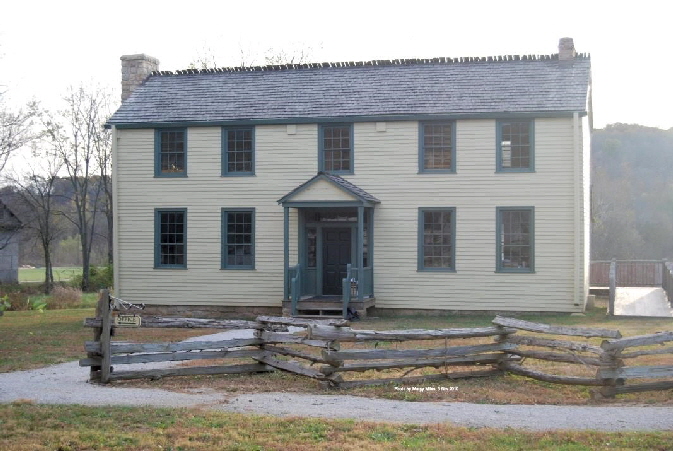
Flanders home today

The Flanders and Jemima (Boone) Callaway House was dismantled and moved from La Charrette Village near Marthasville, Missouri, to Boonesfield Village near Defiance, Missouri, and rebuilt to appear as it would have in the mid-19th century; new siding was installed to protect the original walnut logs as was done earlier. Photo by Margy Miles, November 3, 2010.

Elizabeth. Betsy (Elizabeth) Callaway Henderson was the daughter of Richard and Frances Walton Callaway. She and Fanny were born into the luxuries afforded by a prosperous colonial Virginia plantation. Betsy was born in 1760 in Virginia and came to Boonesborough in 1775 with her sister Frances after their mother had died. The sisters were present during the Siege of Boonesbourgh. She and Frances helped mold musket balls for the men to use, and both frequently fired weapons at the Indians. She married Colonel Samuel Henderson, one of her rescuers, three weeks after her rescue. It was the first wedding performed at Fort Boonesborough. They reportedly had ten, eleven, or even as many as twelve children by different accounts, one of which is reported to have been the first white child born in Kentucky; thus making this ‘two firsts’ for the couple.

Elizabeth and Samuel are said to have moved back to North Carolina in the fall of 1777. Later they moved to Franklin County, Tennessee, in 1807. Elizabeth passed away in 1815 and was buried beside her husband near McMinnville, Warren County, Tennessee.

It appears that Samuel and Betsy had a more stable life than her sister Fanny. One may wonder whether the sisters ever saw one another again after she and Colonel Henderson moved from Kentucky to Tennessee.

Frances. Fanny (Frances) was born in 1763 on her parent’s plantation in Virginia. Her mother Frances passed away when she was only 13, but she and older sister Betsy accompanied her father Colonel Richard Callaway to Fort Boonesbourgh in 1775. She was about 14 when captured by Indians. She also helped mold bullets with Jemima and Betsy during the Siege of 1778 while the men were fired their long guns at the Indians. All three girls were said to have repeatedly fired weapons as well in defense of the Fort. Fanny was about 17 years old when her father was ambushed, killed and mutilated by Indians when working on the first chartered ferry to operate on the Kentucky Riverin 1779.

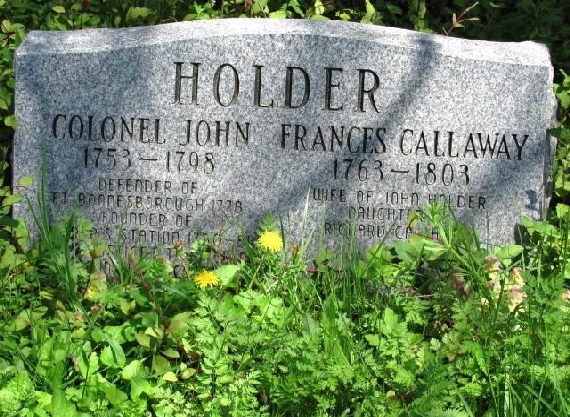
In 1782 or 1783 Fanny married John Holder, who came to Fort Boonesborough during the Revolutionary War, where he had previously fought alongside George Washington. He was present at the Fort during the Siege of 1778 and later commanded the Fort. He was a business entrepreneur whose businesses included a store, warehouse, boatyard, tavern, and gristmill near the mouth of Howard’s creek, about one mile downstream from Fort Boonesborough. This is in present-day Clark County, part of the Lower Howard’s Creek Nature and Heritage Preserve area. This was the beginning of one of the earliest industrial centers in Kentucky during the late 1700’s. John accumulated considerable wealth and had acquired over 100,000 acres in Kentucky by himself or in partnership with others at one point. He was also very influential in local government and the militia. During this period Fanny became one of the leading ladies in Clark County. She and John are buried on a prominent hilltop overlooking Lower Howards Creek (see photo of new gravestone below). They had eight children. Their life took a turn for the worse when they experienced a myriad of financial troubles from which they never recovered. During these tumultuous times, John passed away in 1779.  Fanny then married Captain John McGuire in 1802, and they had a daughter named Betsy. However, Fanny passed away in 1803 and six of the children she had with John that were living with her at the time were found homes with relatives and others. What happened to Betsy Holder McGuire isn’t known.

Holder Grave marker

Marvin Davis, June 1, 2013

The graves of John and Fanny can’t be definitively located. However, based on historical accounts and anecdotal evidence, it’s believed to be on the Holder farm near where Holder’s Station was located. The above modern gravestone was installed and dedicated by the Clark County Historical Society on October 17, 1998, although the date inscribed on the stone showing John Holder died in 1798 is incorrect. Historical accounts have him alive and serving as Colonel of the 17th Regiment of the Kentucky militia until his death, which was reported by daughter Rhoda Vaughn as March 30, 1799.

Suggested Reading:

Boone by JohnMack Faragher

Faragher, John Mack. 1992. Daniel Boone, The Life and Legend of an American Pioneer. 429 pages.

My Father Daniel Boone

Hammon, Neal O., editor. 1999. My Father Daniel Boone. The Draper Interview with Nathan Boone. 176 pages.

Boone by Robert Morgan
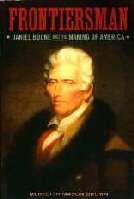
Frontiersman

Morgan, Robert. 2007. Boone - A Biography. 538 pages.

Brown, Meredith Mason. 2008. FRONTIERSMAN, Daniel Boone and the Making of America. 375 pages.

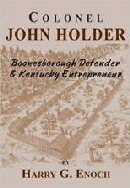
Holder

Enoch, Harry G. 2009. Colonel John Holder, Boonesborough Defender & Kentucky Entrepreneur. 288 pages.

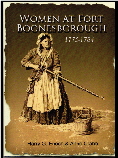
Women of Boonesborough lg

Enoch, Harry G., A. Crabb. 2014. Women at Fort Boonesborough, 1775-1784.  174 pages.


© 2008-2025   ALL RIGHTS RESERVED FORT BOONESBOROUGH FOUNDATION
 Website maintained by Graphic Enterprises


blogspot statistics